Art Materials
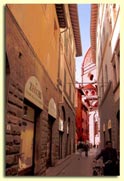
Art is a subjective field, what one person may like, another may not. There is very little that an artist can do about this toward making his or her artwork accepted by the mainstream of our capricious art world. One of the best ways to ensure a happy art connoisseur is to use the best quality materials. Toward this goal I have had the immense pleasure to buy my art supplies at Zecchi Fine Art and Restoration Materials. Zecchi is the kind of store that artists dream about. Located in Florence’s Historical Center, right at the Duomo, Zecchi offers a suggestive view of the Duomo, as well as an unparalleled service. At the Academy of Art College in San Francisco I learned about materials and how they can be used to create artworks. However, I didn't learn everything there and sometimes I need help with the development of a project by using new materials and techniques.
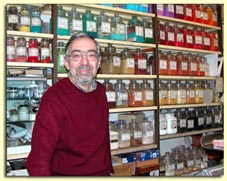 Sandro Zecchi Store Owner
Envisioning a project in my head is easy, the trick is to make the idea come to life. To do this you need materials; paint, canvas, brushes, mediums, and thousands of other products. Choosing the correct materials for the project that you have in mind is fundamental. I have asked hundreds of questions to the staff at Zecchi’s about their products and they have always given me good guidance. They have saved me a lot of headaches in the past because I tend to get it right the first time based on their advise. They have been helping artists in Florence since 1956. They specialize in antique techniques from the time of the Renaissance, and art restoration. For modern artists they also provide all that you need. They speak perfect English, and they give student discounts, contact them to see if your school is affiliated.
If you can't make it to Florence in person, you can order on-line Zecchi's artistic materials, Send Sandro or Massimo Zecchi an e-mail today to get started with the best art supplies around.
Zecchi Colori Belli Arti & Restauro - Fine Arts & Conservation
Via dello Studio, 19r / 50122 Firenze, Italia
www.zecchi.com - zecchifi@tin.it - www.zecchi.it
Tel. +39 (055) 211470 / Fax +39 (055) 210690
The materials I use:
Zecchi Extrafini Oil paint for artists, made especially for Zecchi Colori Belli Arti & Restauro, I have found that these paints, made here in Tuscany are superior to almost everything I have used up until now. I also use:
Maimeri Puro™ Oil Paint: In Italian, Puro means pure. These tubes of paint offer a higher amount of pigment. This means that the paint is intense with color. Some of the tubes are really heavy because of the ratio of additives to pigment. This is good because I like rich vibrant colors.
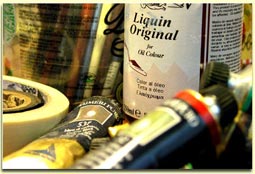
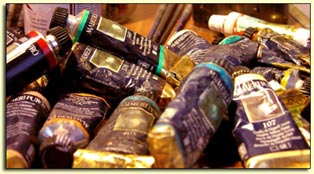
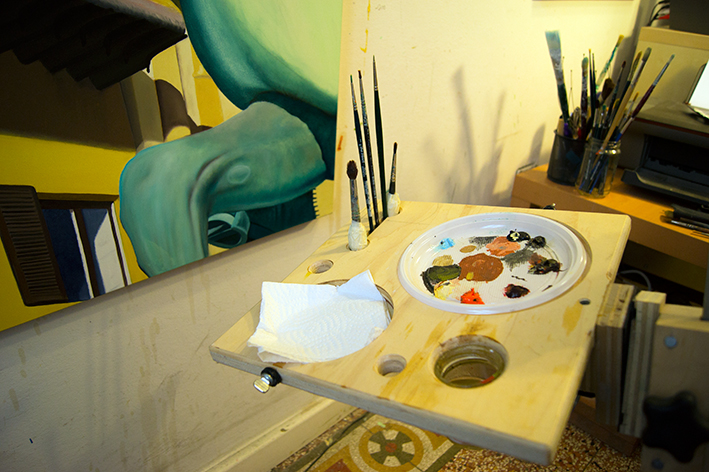
Matthew Bates' Workspace - Original support made by my father Stephen Bates and Hugh Belton
Fine Prepared Canvas: I have only found these canvases at Zecchi’s. I like to make fine details come to life and the structure of the canvas can get in the way if the canvas is too coarse. Some people add gesso to the canvases and smooth them down, but this takes away from the natural pull that the canvas gives to the brush and I like that sensation while I paint. I always buy prepared canvases (already gessoed), and I stretch that canvases on a wooden frame myself.
Brushes: I have used expensive brushes in the past, and they are hard to maintain because they are made from actual animal hair. For this reason I tend to use synthetic brushes which are much more durable in the long run. I do use Martora Kolinsky Sable brushes as they are very useful for small details.
Mediums: In general I use white spirit to dilute and clean, while I use an Alchid Light Medium, also made by Zecchi, for painting purposes. I have found that this drying agent allows you to paint faster adding glaze after glaze in much less time. It also has the amazing quality that it goes on the canvas smooth as silk, making it easier to extend the reach of each brushstroke. Adding Linseed oil to the mix allows for further coverage, making the paints have a glossy luminance when the paints have dried.
Airbrush: I don’t always use this incredible tool, but sometimes it makes the difference to the project. The ability the airbrush gives you to create even colors and blurring effects is next to impossible with the use of a paintbrush, especially over large areas of canvas.
Computer: Yes, it is 2014, and the computer has become a huge part of every aspect of our lives. Even in fine art painting, the computer is fundamental. The ability to create project work ups with the computer has helped me to visualize the final idea which will become the actual painting. Once there was the “cartoon” which was a drawing to present to the client and help the artist to create the final painting. Now with the computer we are able to go much farther toward the final image, and even though the canvas is painted by hand, the idea is created digitally, making details stronger and the overall design with few if any flaws.
Digital Camera: Hand in hand with the computer is the digital camera. Since I paint primarily realistic subjects the digital camera allows me to take hundreds of pictures to create a project. By taking pictures which I can easily put into the computer, I am able to manipulate the images in a way that was impossible before. Now my projects are larger and more complicated, mostly thanks to this technology.
Visit Matthew Bates Painting Galleries:©2014, Matthew Bates, Firenze, Italia