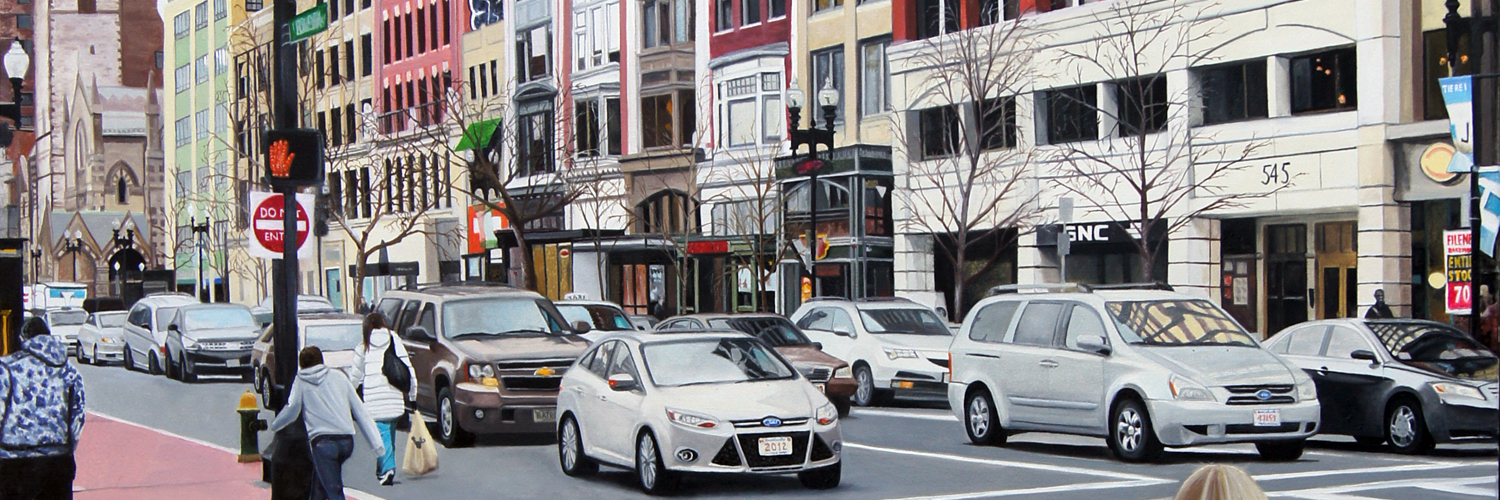
Copley Square, Boston
An essay by Matthew Holden Bates
Firenze, March 2012
When I begin a work of art, I always spend time looking carefully at the preparation photos to make sure the subject is worthy of my time and has the potential to become a strong painting. For a still life or a smaller work, the subject matter can be simple, breezy, and of little consequence. It is enough that it is beautiful.
With city paintings, the complexity changes. The motivations behind the work have to be deeper. The image has to hold more than architecture and light. It has to carry a reason. For this painting, we have to go back more than twenty years to understand why the subject is so dear to me.
A Teacher, a City, and an Idea
When I was a sophomore at the Academy of Art College in San Francisco, way back in 1989, I had an art teacher who helped pave the way toward my professional and private life. His name is Thomas Marsh, and he is a world-class sculptor. His ability to draw was phenomenal.
In his class, Anatomy for Artists, we studied the human body in a non-medical fashion: bones and muscles. Professor Marsh would draw bones on the chalkboard with colored chalk, then fill in the muscles on top with another color. The effect was magical. When he erased the board, we would all shudder, knowing that the world had just lost a great masterpiece of improvised art.
I became more and more impressed by him. Then, on a random day in the fall of 1989, he sat us down in a semicircle and started telling us that if we considered ourselves artists, we had to visit Florence, Italy.
We were in a studio on the other side of the world, in San Francisco, and his words seemed bold at best. When he started giving directions from the train station to Michelangelo’s David, we all thought he was quite mad. But the germ of an idea was planted in my head, one that would change my life.
Boston, Back Bay, and the Decision
Fast forward to Christmas vacation of that same year. I had a month-long break, so I went home to Washington, D.C. for the holidays. I got back in touch with my old friends and was glad to be on familiar turf. I spent most of my free time with my best friend, Jermaine. We had been friends for years, and we always had a good time together.
Jermaine went to Emerson College in Boston, and since I had a longer break than he did, I decided to go up to Boston to visit him.
My mother’s family is from Cambridge, and I had spent most summers in Manchester-by-the-Sea, so I was very familiar with Boston, but always in the context of family gatherings in what I thought of as stuffy New England.
I was surprised to discover that Boston had another side: a youthful, energetic side I had never seen before. Jermaine’s apartment was in the Back Bay, with an amazing view of the Citgo sign from the top floor of his building. We would wander up and down Newbury Street, between bars, bookstores, and Tower Records at the end of the block.
I loved the energy: all the students, the musicians from Berklee, and the sense that the whole city was full of people beginning their lives. Boston has so many schools that the city itself seemed like a campus. For the first time in my life, New England felt exciting.
It was during that visit that I made the decision to go to Florence for my junior year of college. We were riding a wave of sophomoric adrenaline, and I remember sitting in the lobby of Jermaine’s building, hatching the plan to go to Italy. It felt epic. A real miracle. Who does something like that?
It happened in Boston’s Back Bay in early 1990.
That spring, I signed up for a Florence program and was accepted. In no time at all, I was on a plane to Firenze, Italy, where I am writing this essay twenty-two years later. My life was forever changed by a decision I made in Boston. So when I decided to paint Boston, it felt right that the painting should be of the Back Bay, just a few blocks from where Jermaine lived.
Jermaine in the Painting
I say “where Jermaine lived” because, in 2008, Jermaine passed away. My best friend in the whole world is no longer with us.
The thing about Jermaine was that he loved life. When he was in Boston, his life was filled with promise. After graduating from Emerson, he earned his master’s degree at Northeastern, and his future looked bright. For reasons I will never completely understand, he moved from Boston, where he had lived for years, back to Washington, D.C. There, something changed. He became unemployed, then depressed. In the end, I hardly knew him anymore.
That is why I painted him into this painting.
A painting is like a parallel dimension. It is a window into the soul of the artist, a place where magic can happen. In my painting, Jermaine never left Boston. He is still smiling at us from across Boylston Street. He is successful and happy, the way he was when he lived there.
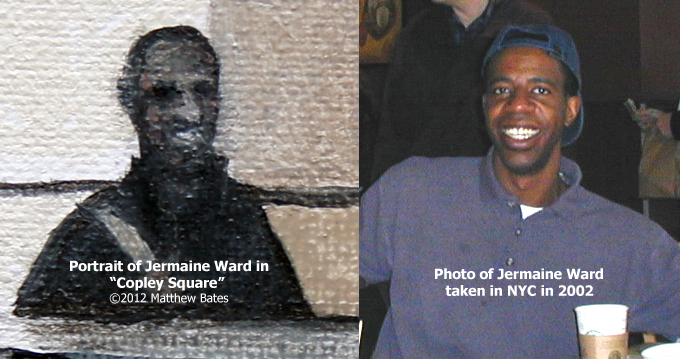
Jermaine appears in the painting, smiling from across Boylston Street.
Changing Reality on Canvas
There are other things I altered so that the painting would have a better feeling. In the original photos of Copley Square, there was a traffic camera, big-brother style, dominating the sky at the intersection. I removed it from my design because it had no place in the alternate dimension I was creating on canvas.
If you look carefully at the car in front of Wendy’s, you will see that the Prudential Building is reflected in the window. I was originally going to include that building more directly in the design, but I liked having Old South Church as the main focus in the background. I am happy that the Prudential Building is still present, even if only as a reflection.
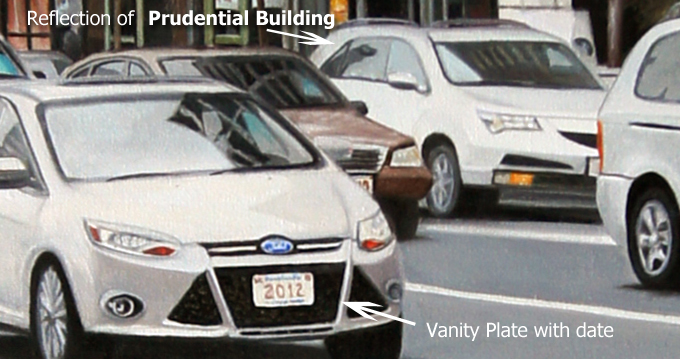
Details from the painting, including reflections and altered elements.
Hidden Signatures
I have never been a fan of signatures that are visible in the corner of a painting, so I always try to design my name into the subject itself. This is something I saw Richard Estes do, and I have successfully added my name to several of my large cityscapes.
In this painting of Boston, I added my name all over the place. It is written on the bag carried by the blonde woman, twice, and on the license plate of the Chevy SUV. The year of the painting is also on the bag and on the license plate of the Ford Focus.
The license plate on the Ford has a double meaning because it is not only the year, but also a Massachusetts status symbol. I should know. My grandmother had one, and believe me, it was a big deal. She got it from her mother, and now my second cousin drives around with a four-digit plate that has been in my family for generations.
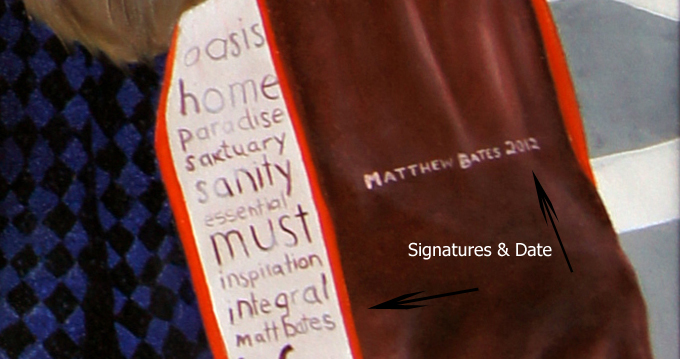
Hidden signatures and dates designed into the painting.
Winter in Boston
This is a winter scene. There are numerous trees in the painting, all without leaves. The mood is winter gray. That is how I think of Boston, and it is the dominant color of the painting. The splashes of color are all man-made and intentionally bright, asking for your attention like advertising in a magazine. Yet the overall mood of winter in Boston prevails, making those colors look slightly silly and overstated.
The blonde woman in the foreground is a detailed and complex subject. I do not know who she really is, of course, but in the alternate dimension of the painting she becomes a kind of Boston archetype. Her black boots are firmly rooted to the ground, like her New England pedigree. She is rich, and she knows it. Her hair is flawless, perhaps her greatest feature, the sort of hair that suggests time, money, and ritual. She lives in a world of shopping, private money, polished surfaces, and careful routines. She may spend her husband’s cash, but ironically, she has her own money too, so she has nothing to worry about except fashion, fitness, and maintaining the life she already possesses.
In my imagination, she loves riding horses and sailing in the summer when she is at her beach house on Nantucket. This is a young woman who knows her place in the world and is very happy to take it.
She is also juxtaposed against the upper half of the painting, which in terms of design is her exact opposite. She represents detail in a field of no detail: the street. If you look up at the top half of the painting, the closest streetlamp mirrors her in reverse. It is simple, without detail, in a field of absolute detail: the buildings and cars. She has black boots, and the lamppost has two white lamps, which echo those boots as a visual inversion. This happened because I removed the big-brother camera from the scene, creating an unexpected design feature.
Boston and the Realist Tradition
Boston has always been a part of my life, and I am happy to have made this painting. The Boston School of painters faithfully taught the skill of painting reality. Although I would not consider myself part of that school, I feel a certain happiness thinking about the great artists who followed the realist tradition, from Sargent to Whistler to Edward Hopper. They all had a wanderlust for traveling the world, and like me, they had origins in New England.
By Matthew Bates
Firenze, March 24, 2012
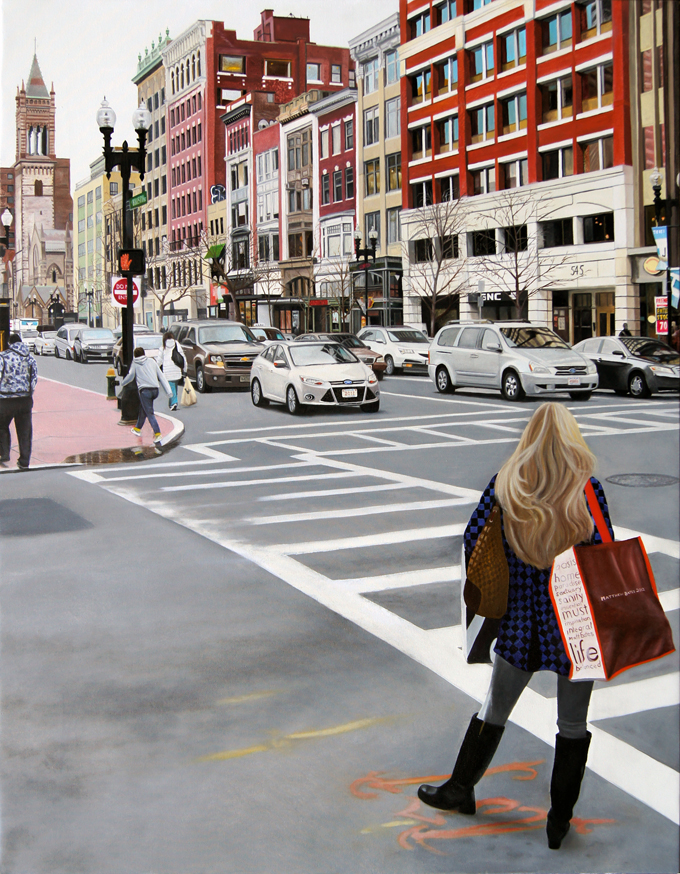
Copley Square, oil on canvas, 70cm x 90cm.