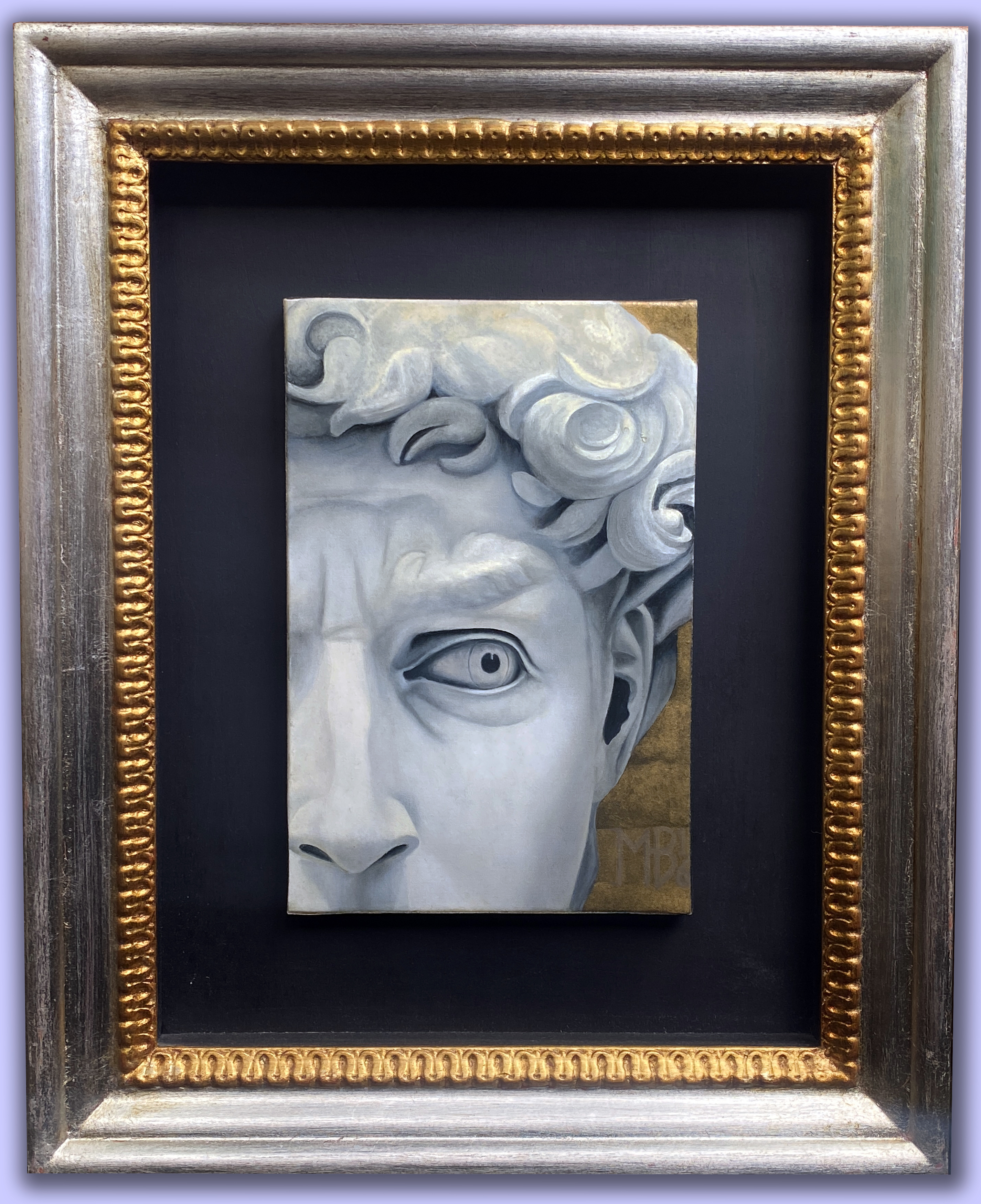
In 1501, a young man of twenty-six returned to Florence from Rome. Florence was the place to be for an ambitious artist, and it was his home. He arrived ready for his next great challenge. He had grown up in the court of Lorenzo de’ Medici. As a boy, he lived in the Palazzo Medici, invited there after Lorenzo recognized his extraordinary talent. Lorenzo sought to transform Florence into a new Athens, elevating humanistic ideals above the feudal traditions that had long defined society. Scholars were drawn from across the world, gathering to study ancient texts and imagine a different kind of civilization.
In this rarefied environment, the young artist absorbed both craft and philosophy. He was shaped not only by technique, but by ideas, and by the belief that a man should be judged by his achievements, not by wealth or birth. Few artists of his time received such an education. His sensitivity to form and beauty was forged in this unique setting.
He was not merely a craftsman or a mason. He was an artist, through and through.
In Rome, Michelangelo had just completed the Pietà, a sculpture of extraordinary beauty, commissioned by the French Cardinal Jean de Bilhères. Word of it spread quickly, reaching Florence’s wealthy and influential elite and stirring anticipation about what the young artist would create next. A new commission was inevitable.
Near the base of Brunelleschi’s dome, in the Duomo workshop, stood a massive block of marble. It had been abandoned for decades, dismissed as flawed and unusable. Agostino di Duccio had begun carving it in 1465 but quickly gave up, fearing the stone would fail. Years later, Antonio Rossellino made a similar attempt, with the same result. For nearly fifty years, the scarred block remained in the courtyard, a problem no one could solve. The effort required to bring such a piece from Carrara to Florence was immense. It had been cut from the mountain, hauled down treacherous terrain, loaded onto a boat, and transported up the Arno. All of this for a block that had yielded nothing.
At some point, Michelangelo turned his attention to it.
Whether he had seen it before, or recognized its potential only then, we cannot know. But where others saw ruin, he saw possibility. Fresh from his triumph in Rome, he now had the reputation, and the confidence, to claim it and attempt what others had abandoned.
The completed statue was originally intended for the cathedral, to be placed atop a buttress beneath the dome. The choice may have been partly practical, as the Duccio block stood directly below that very location. Once agreements were reached and contracts secured, Michelangelo was given permission to begin.
He would have prepared carefully, studying the damaged surface and adapting his vision to its limitations. The previous attempts had left their mark, forcing him to work not with an ideal form, but with a compromised one. His decision to carve a monumental, free-standing nude figure from this block was audacious. No sculptor had attempted such a feat in marble since antiquity. It must have seemed, to many, impossible. There was likely skepticism, perhaps even quiet wagers on whether the marble would hold or fail. For decades, the block had been a burden in the workshop. Now, at last, it had found its sculptor.
After the block was raised upright, Michelangelo constructed walls around it, shielding his work from prying eyes. A deeply private and proud man, he wanted full and undisputed credit for what he would bring forth. In late 1501, he withdrew from the city, immersing himself entirely in the task. He worked relentlessly, with little regard for comfort. While other artists moved easily among patrons and courts, Michelangelo labored in isolation, driven by something far more demanding. He may have slept on-site, unwilling to leave the work unattended. For nearly three years, he endured the heat of Florentine summers and the damp chill of winter, returning each day to the same block of stone, pushing it toward its final form. The man himself must have reflected that intensity. His body hardened by labor, his features marked by experience, he stood in stark contrast to the elegance often associated with artists of the time. He was not refined. He was formidable.
Florence held another kind of artist. Leonardo da Vinci, a generation older, moved comfortably among the elite, known for his refinement, his intellect, and his grace. Where Michelangelo was driven inward, Leonardo moved outward. Where one carved in solitude, the other observed, studied, and painted within the world of courts and patrons.
The two could not have been more different.
And yet, at this moment, they were working in parallel. While Michelangelo labored behind walls, bringing the David into being, Leonardo was painting the Mona Lisa. Two visions of human perfection, emerging at the same time, in the same city, through entirely different hands.
When the sculpture was finally completed, its greatness was undeniable. It could not be placed high on the cathedral, where it would be diminished by distance. After much debate, it was decided to install it before the entrance of Palazzo Vecchio at the heart of Florence’s civic life. The journey there was an event in itself. Encased in a massive wooden structure, the statue was moved slowly through the city over several days, traveling from the Duomo to Piazza della Signoria.
When it arrived, the people of Florence saw it for the first time. The effect must have been extraordinary. Before them stood a colossal figure, carved from a block once thought unusable. A marble giant, exposed and unguarded. The surface seemed alive. The chest appeared to breathe. The face held a tension that was both calm and alert, poised between stillness and action.
It wasn’t until I painted a detail of David’s face that I began to understand what Michelangelo had truly created.
This is not the familiar image of victory. Goliath is nowhere to be seen. Instead, we are given something far more unsettling, a towering young man, exposed and alone, suspended in the instant before action. His weapon is hidden. In one hand, a stone, barely visible between his fingers. The sling wraps behind his back, almost disappearing from view. Everything is held in reserve.
This is the moment before the strike.
We, as readers of the biblical story, know what will happen. We know that David will win, that he will become king, that his name will endure. But David does not know this. He stands in uncertainty, facing something far greater than himself. And in that realization, the figure changes.
He is not triumphant. He is afraid.
He conceals his intent, holding everything within, standing as if nothing is about to happen. He knows this is his moment. He must act now, or he will die.
And yet, he cannot act through force alone.
In that suspended instant, something deeper takes hold. David must let go of himself, of fear, of doubt, of the illusion of control. He must surrender.
It is only through that surrender that he can act at all.
In this, I believe Michelangelo gives us something extraordinary. David does not win through strength, but through the moment in which he ceases to rely on himself. His gaze becomes more than human, as if something beyond him has entered the act.
We are not simply looking at David.
We are looking through him.
And in that moment, we understand something else. Michelangelo has not only sculpted a biblical hero, but a symbol. David is no longer the small figure facing the giant.
He is the giant.
Seventeen feet tall, standing in the heart of Florence, he transforms the story itself. The unseen Goliath is no longer a man, but the world beyond the city’s walls, larger, more powerful, always threatening.
Florence, like David, stands exposed. Small in size, yet immense in culture, in influence, in ambition. In the time of the Republic, this was no abstract idea. It was a lived reality. And just as in the story, the outcome feels inevitable.
Not because David knows he will win. But because he is willing, in that moment, to surrender everything.
From a block of marble that had sat in the Duomo workshop for decades, a symbol emerged, one that would come to define a city. Florence is small, bound by its geography, set along a narrow river in a quiet land that lies on the road to Rome. For centuries, armies passed through it on their way south. Its survival was never guaranteed. It endured through intelligence, through wealth, and through a constant awareness of its own vulnerability.
The people of Florence knew how fragile their position was. They knew they were small in comparison to the forces that surrounded them.
And then they saw the David.
Seventeen feet tall, standing before their seat of government, it transformed the story itself. No longer the boy facing the giant, but the giant made visible. The unseen Goliath was no longer a man, but the world beyond the city’s walls, larger, more powerful, always threatening.
And yet, David stands.
Not through certainty. Not through strength alone.
But through that moment of surrender. The same moment in which his gaze becomes something greater than himself. In that sense, Michelangelo did more than sculpt a biblical figure. He gave Florence an image of itself.
David is Florence.
And Florence, against all odds, endures.
©2025-2026, Matthew Holden Bates, Firenze Italy—All Rights Reserved